
Industry
Insights
Filter

Industrial UPS Systems for Automated Manufacturing: Why Seconds of Downtime Cost Hours of Production
A Momentary Power Blip Can Shut Down an Entire Line You don't need a multi-hour blackout to lose a shift's worth of production. On a modern...
Short Circuit Battery Installation Damage
Introduction
An electrical contractor created a short circuit during a battery installation. In 2016, we received ...
Testing Internal Resistance of VRLA Batteries
Introduction
Battery system maintenance and monitoring are key elements in the reliability of any DC battery ...
Tubular vs. Flat Plate Battery Design
Introduction
Lead-acid batteries have been around for more than 150 years. While flat plate models with a lattice ...
Battery Damage Caused by Unqualified Installers
Introduction
An electrical contractor damaged jars during installation resulting in delayed leaks surfacing after ...
Battery Warranties Explained
Introduction: Battery Warranties
The idea of the 20-year warranty began in the 1960s as a marketing campaign for ...
The Risks of Unmonitored Hydrogen in Motive Power Applications
Introduction: Hydrogen Risks in Industrial Settings
From lead acid to LiOn to NiCad, all batteries produce ...
Managing Temperature Extremes in Substation Battery Applications
Introduction
• Over the course of one year, SBS assessed multiple 125-volt DC substation battery systems in ...
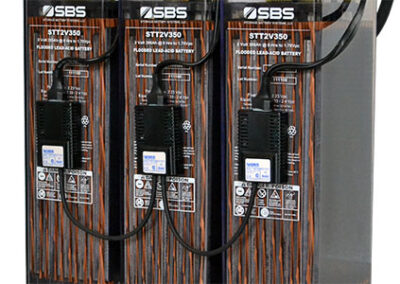
EquaLink Battery Management System
Product News Release – Announcing New Battery Management System
The EquaLink Battery Management System (BMS), delivers a complete and comprehensive diagnostic and monitoring solution for critical battery maintenance programs and required NERC / IEEE reporting.
Menomonee Falls, Wisconsin, February 5, 2016 – SBS Testing and Monitoring, a division of Storage Battery Systems, LLC (SBS), an industry leader in battery testing equipment and Power Solutions™, is pleased to announce the release of their new EquaLink Battery Management and Monitoring System.

National Forklift Safety Day
National Forklift Safety Day is June 14, 2022. Exponential Power’s team of professionals is proactive in creating and nurturing safe workplace environments, and we’re honored to be part of this national focus on forklift safety.
Part 2: Can your generation plant survive an unplanned or emergency trip without sustaining major damage?
TEST EQUIPMENT
The equipment used in a capacity test should be a computer-based battery discharge test system with automatic data logging.
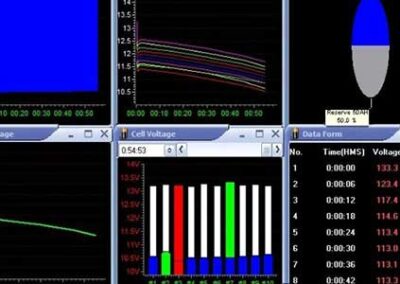
It should be capable of conducting single or multiple steps, constant current or constant power (kilowatt) discharge tests. It should include a video display of all pertinent data relating to a discharge test such as individual cell voltages, load current, overall battery voltage, average cell voltage, minimum cell voltage, maximum cell voltage, elapsed test time, program step number and program step elapsed time, battery location and battery identification number.
5 Common Mistakes in Battery System Capacity Testing
IEEE and NERC both require battery capacity testing as a means of predicting a battery system’s ability to perform when called upon during a loss of AC power, for acceptance of new installations, and in determination of end of life criteria for system replacement. While NERC is very vague and just states that “Capacity testing must be done at said interval”, IEEE 450, 1106 and 1188 have clearly defined frequencies, prerequisites and instructions on how these tests should be conducted.
From results that are submitted to us for warranty consideration or review, a group of common errors have come to light. Below are the top 5 most common mistakes that are seen in capacity testing.
Part 1: Can your generation plant survive an unplanned or emergency trip without sustaining major damage?
INTRODUCTION
Good question, and one your insurance company or investors are likely to ask and want documentation on.
The heart of the safety system that allows for an orderly and safe generating unit shutdown is the station battery and associated DC system. The generating unit will sustain major or even catastrophic damage if the station battery and associated DC system fail to perform as specified in the system design criteria.
No results found.