
Why Multi-Site Data Center Operators Need a Better Approach to UPS Battery Maintenance, Monitoring and Lifecycle Management
Data center power gets plenty of attention right now. Much of the discussion focuses on the impact on local communities, grid capacity, long lead times for equipment such as transformers, and delays in utility interconnections.
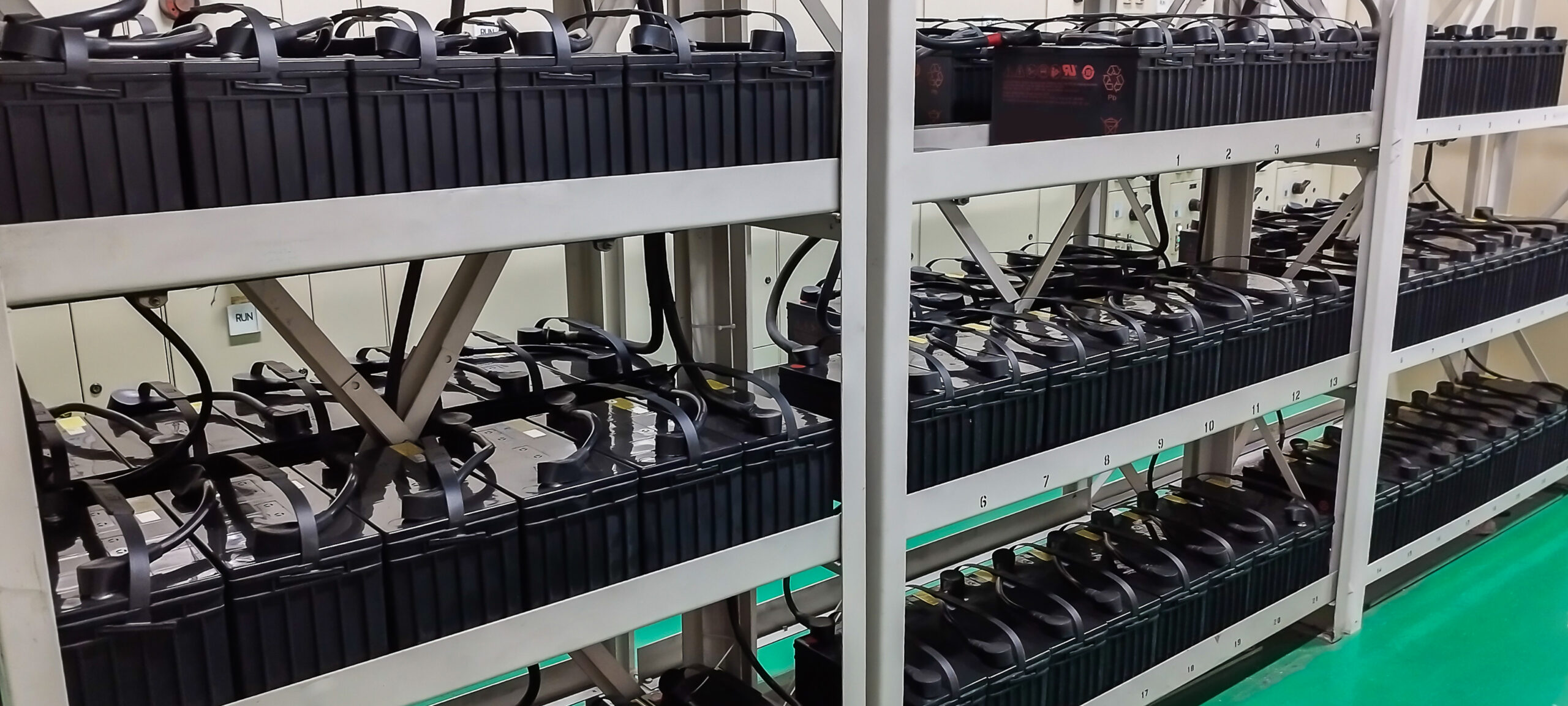
For companies already operating data centers, including colocation, enterprise and regional facilities, a less visible power risk sits in the battery room.
During a utility outage or power sag, UPS batteries provide immediate and uninterrupted power to critical load until backup generators are online and synchronized. Even though this gap is usually measured in seconds or minutes, battery performance is crucial. A single failed battery can weaken an entire string, increasing the risk of an unexpected outage during a utility event.
An operator may have thousands of stationary batteries across dozens of facilities. Some sites use conventional flat-plate valve-regulated lead-acid (VRLA) batteries. Others use Thin Plate Pure Lead (TPPL), a VRLA design built with thin plates of high-purity lead. Newer facilities may have lithium-ion UPS battery systems.
Each location can also have its own equipment, service providers, monitoring capabilities, maintenance practices and replacement schedules. Over time, a multi-site data center portfolio can become a mixed bag of different battery programs.
How Data Center Battery Programs Become Fragmented
Most multi-site portfolios grow in pieces. A company opens a facility in Chicago, acquires another in Dallas, expands in Ashburn and adds a data center in Phoenix. Equipment standards change, battery technology evolves, service contracts expire, and local teams make reasonable decisions based on what each site needs at the time.
Years later, the corporate infrastructure team may be managing a mix of:
- Conventional VRLA, TPPL and lithium-ion batteries.
- Multiple UPS manufacturers and configurations.
- Local, regional and national battery service providers.
- Different preventive maintenance procedures.
- Remote battery monitoring at some sites and not at others.
- Battery data spread across building management systems, spreadsheets, OEM portals and paper records.
- Different battery replacement programs.
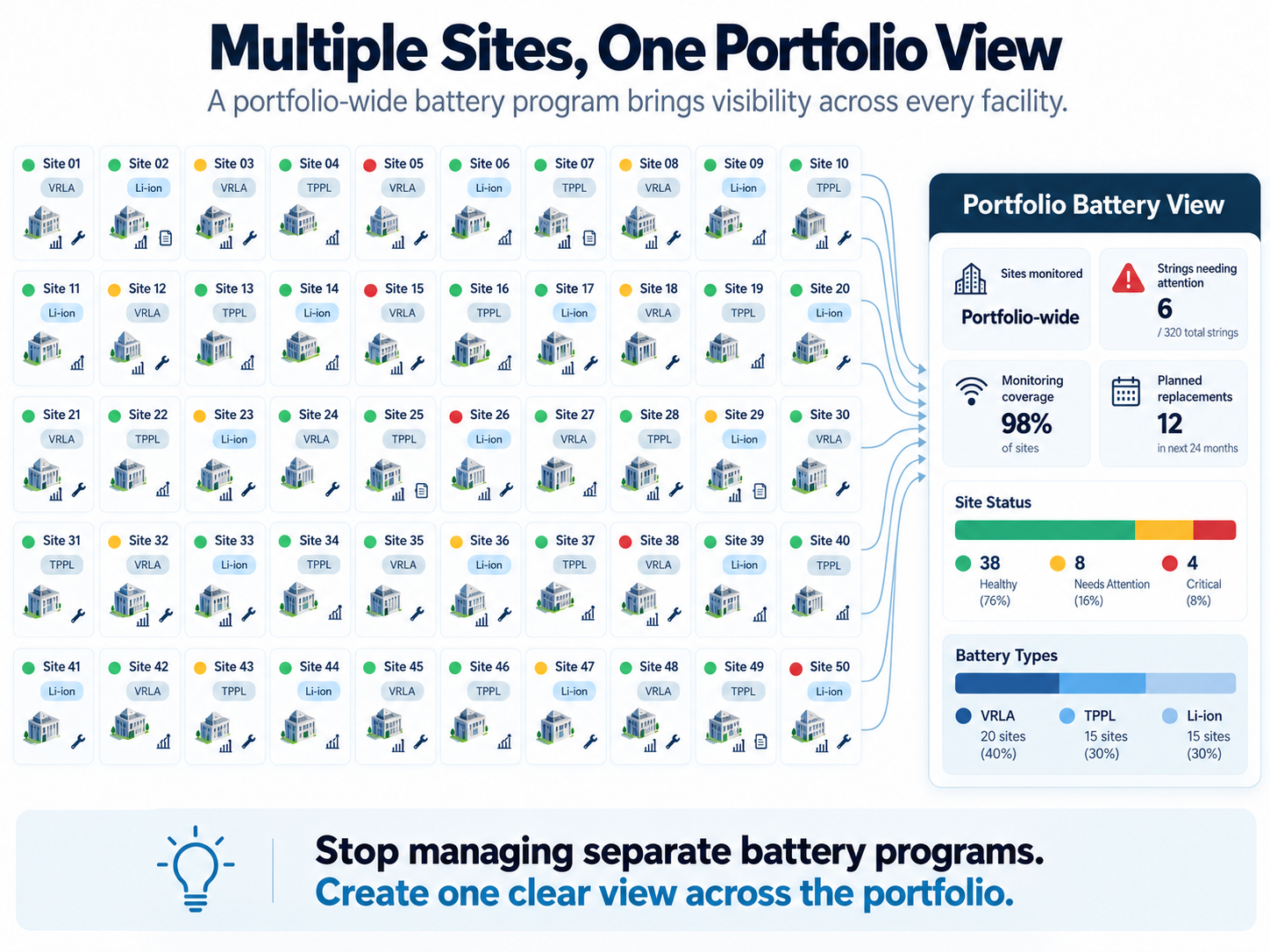
The information usually exists somewhere. The problem is seeing the whole portfolio in one place.
Can the person responsible for the portfolio quickly answer these questions?
- Which battery strings are showing signs of deterioration?
- Which batteries or strings are approaching end of life or require replacement?
- Which facilities have remote battery monitoring, and which do not?
- Where and how do maintenance practices differ from site to site?
- What battery-related capital spending should be planned for the next 12, 24 and 36 months?
Those questions are much harder to answer when every site operates independently.
Why Battery Visibility Matters for Data Centers
UPS batteries remain on float charge for most of their service life, ready to deliver immediate power when a utility disturbance occurs.
Age is one indicator of battery condition, but it does not tell the whole story. Temperature, charging conditions, float voltage, discharge history, installation quality and operating environment all influence performance and service life. Battery strings installed on the same day, even at different sites, may age at very different rates.
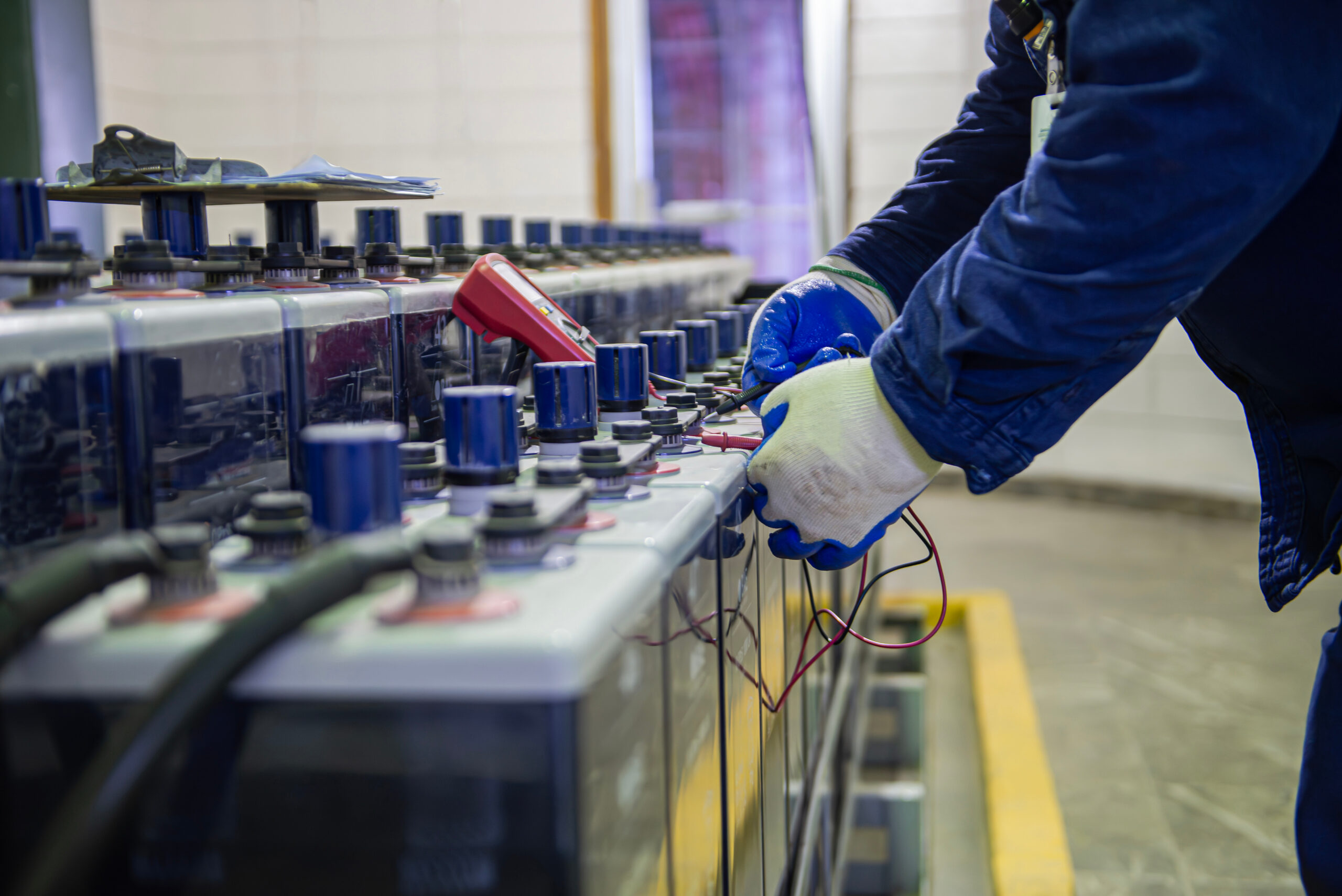
For lead-acid batteries, including conventional VRLA and TPPL, testing and monitoring typically include measurements of individual battery voltage, temperature and internal resistance or impedance. Trending these readings over time reveals meaningful changes. A battery whose impedance begins to diverge from the rest of the string, or shows unusual voltage or temperature behavior, requires attention.
Lithium-ion systems work differently. Their built-in battery management system (BMS) continuously tracks cell voltages, temperatures and state of charge, and it often holds the most useful condition data. A portfolio program needs a way to bring that BMS data into the same view as the lead-acid sites.
Remote battery monitoring adds continuous visibility in between scheduled preventive maintenance visits. For a multi-site operator, it becomes far more valuable when every site reports into a common view.
At that point, the question shifts from “Did this site complete its battery maintenance?” to “Which UPS battery strings across our portfolio need attention?” The second question is the one that actually manages risk.
Fragmentation Also Affects Maintenance and Capital Planning
Maintenance practices can vary considerably across a large portfolio. One facility has a comprehensive preventive maintenance program. Another relies mainly on an OEM service agreement. A third follows whatever procedures its local contractor suggests.
Industry guidance gives operators a common starting point. IEEE 1188 covers maintenance and testing of VRLA batteries, which includes TPPL. IEEE 450 covers vented (flooded) lead-acid batteries, which some larger and older facilities still use. IEEE 1184 provides guidance specific to batteries in UPS applications. For lithium-ion, IEEE 1679.1 addresses the characterization and evaluation of lithium-based batteries in stationary applications, and the manufacturer’s requirements govern routine maintenance.
A portfolio-wide program sets a common baseline for inspections, testing, reporting, documentation, monitoring and escalation when a battery or string starts to deteriorate. It also makes replacement planning far more predictable.
Finding deteriorating batteries early gives operators time to source equipment through normal purchasing, schedule technicians, coordinate maintenance windows and budget capital. When a replacement becomes urgent, those options narrow quickly, and emergency work tends to cost more.
With reliable asset records and consistent condition data, operators can build a portfolio-wide lifecycle plan based on chemistry, age, warranty expiration, condition, maintenance history, monitoring data and expected replacement timing. Battery replacement becomes a planned line item in the capital budget instead of a surprise.
Standardize the Process, Not the Battery
Different data centers can have different requirements. Runtime targets, floor space, structural loading, cooling requirements, lifecycle expectations and capital budgets all influence battery selection.
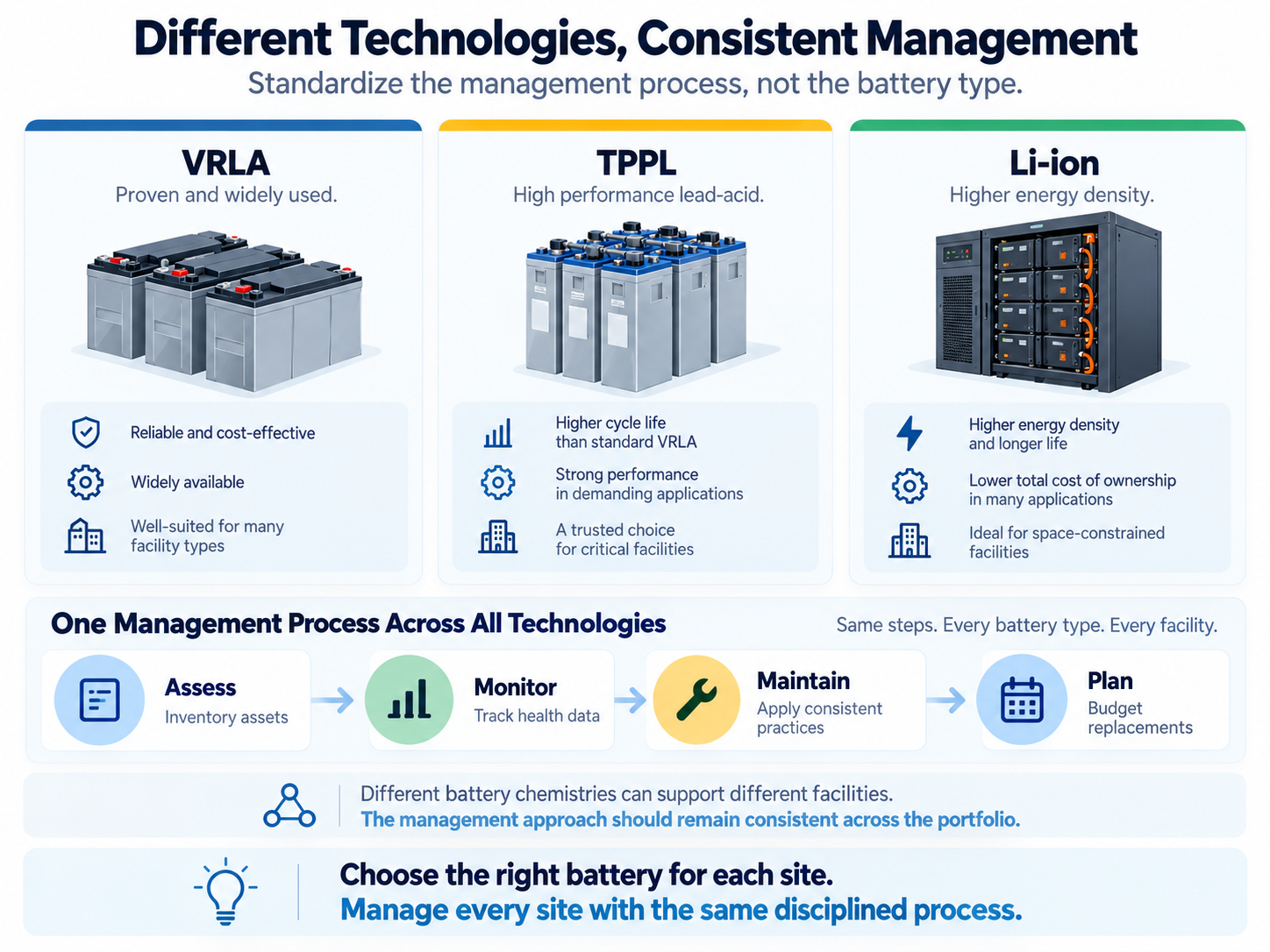
High-rate conventional VRLA may make sense at one facility. TPPL may be the better fit at another. Lithium-ion may suit a newer UPS system where footprint, weight and service life justify its higher upfront cost.
A strong multi-site strategy leaves room for those choices. What it standardizes is the process: how battery systems are assessed, monitored, maintained, documented and replaced at every site. Corporate teams get one consistent view of the portfolio, and each facility maintains the technology that best suits its application.
Start With a Data Center Battery Portfolio Assessment
Before a data center operator can improve the reliability and cost-effectiveness of its battery program, it needs a clear picture of what is currently installed.
A data center battery portfolio assessment establishes that baseline. It documents battery chemistry, age, UPS configuration, current condition, maintenance practices, monitoring coverage and expected replacement timing at every site, then brings the results together in one portfolio view.
The assessment covers every battery brand and chemistry in the portfolio, regardless of the battery manufacturer or installer. Operators receive a site-by-site equipment inventory, a condition-based risk ranking, a gap analysis of monitoring and maintenance intervals and practices, and a 12-, 24- and 36-month replacement forecast.
With that information in one place, operators can close gaps, rank risk and build a predictable battery lifecycle plan.
Regardless of the primary power source, existing facilities have to deliver reliable backup power today. For multi-site operators, that starts with knowing what is installed in every battery room, understanding its condition, identifying the most critical gaps and determining the best approach to preventive maintenance, monitoring and replacement.
Take a Portfolio-Wide Look at Your Data Center Batteries
 Exponential Power supports data center operators with UPS systems, conventional VRLA, TPPL and lithium-ion batteries, battery monitoring systems, preventive maintenance, testing, field service and battery lifecycle planning.
Contact Exponential Power to discuss a data center battery portfolio assessment and identify opportunities to improve reliability, reduce risk and plan future battery investments.